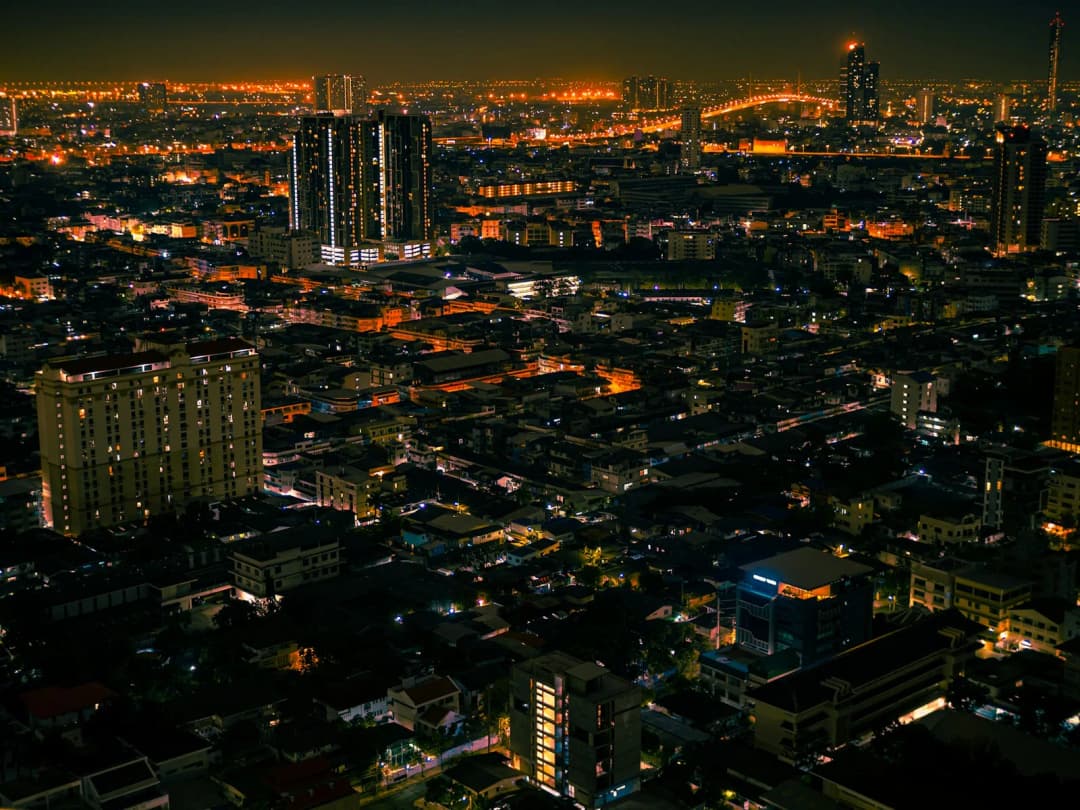
Bangkok is not a walkable city at scale, and which neighborhood you base yourself in changes the entire experience — whether you spend two hours a day in taxis or ten minutes, whether your default dinner is 80 THB street food or 800 THB fine dining, and whether you are surrounded by third-week backpackers or fifteen-year expats. This guide covers the seven neighborhoods where 95% of visitors, expats, and locals with a choice actually live and stay. Each has a distinct personality, a specific BTS or MRT footprint, and a realistic profile of who it works for.
Sukhumvit (Asok, Nana, Phrom Phong, Thonglor, Ekkamai)
Sukhumvit Road is not a neighborhood — it is a 15-kilometer spine that runs east from Central Bangkok with the BTS Green Line running directly above it. The character changes completely every few stations, so "staying in Sukhumvit" is a meaningless phrase. The real question is which stretch.
Asok (BTS Asok / MRT Sukhumvit)
Asok is the central transit interchange — the single BTS-MRT crossover in central Bangkok — and functions as the default mid-range business and short-stay base. Terminal 21 mall, a dense office cluster, and a wide range of three- to four-star hotels from 1,500 to 4,500 THB per night. The nightlife is intense (Soi Cowboy is two blocks north), the street food is good, and you can reach almost anywhere in central Bangkok in under 20 minutes. It is the least charming but most practical Sukhumvit base.
Nana (BTS Nana)
Nana is the most notorious Bangkok neighborhood — adult entertainment and budget tourism concentrated into one intersection. Unless the nightlife is specifically the reason for visiting, skip it as a base. Hotels are cheaper (1,000 to 2,500 THB) but the noise and intensity are not compensated by the savings.
Phrom Phong (BTS Phrom Phong)
Phrom Phong is the Japanese and upper-middle-class expat enclave — Emporium and EmSphere malls, manicured soi, Benjasiri Park, and the highest concentration of authentic Japanese restaurants in the city. Hotel rates run 2,500 to 6,000 THB for solid four-stars. It is quieter than Asok, more family-oriented, and genuinely livable for longer stays. Rents for a one-bedroom studio start around 25,000 THB monthly.
Thonglor (BTS Thong Lo)
Thonglor (Sukhumvit Soi 55) is the bourgeois Bangkok expat capital — the street along which most serious restaurants, craft cocktail bars, specialty coffee, and independent fitness studios have opened in the last decade. It is the most expensive Sukhumvit neighborhood after Central Embassy, with hotels from 3,500 THB and rentals starting around 30,000 THB for a studio. The trade-off is that Thonglor is a long single soi off the BTS — walking the full length takes 25 minutes in the heat, and taxis or motorbike taxis become essential for getting around within the neighborhood. Choose Thonglor if dining and nightlife are the priority.
Ekkamai (BTS Ekkamai)
Ekkamai is one BTS stop east of Thonglor and has absorbed the overflow — cheaper than Thonglor, equally well-connected, with a stronger concentration of younger Thai creatives, specialty cafes, and mid-price restaurants. The Ekkamai bus terminal serves eastern Thailand (Pattaya, Rayong, Trat) making it practical for weekend escapes. Rents are around 20,000 THB for a studio. This is often the smartest Sukhumvit choice for longer stays — Thonglor lifestyle at a 20 to 30% discount.
Silom & Sathorn
Silom and Sathorn form the business and diplomatic district — Bangkok's equivalent of Central London or Midtown Manhattan. The two parallel boulevards run through the financial core, and the character is distinctly different from Sukhumvit: more corporate, more office buildings, fewer bars, more formal dining.
Sathorn (BTS Chong Nonsi / Saint Louis / MRT Lumphini)
Sathorn is embassy row — Goethe Institute, French Embassy, Australian Embassy, and a concentration of five-star hotels (The Sukhothai, COMO Metropolitan, W Bangkok, Banyan Tree). Rentals are among the most expensive in Bangkok at 35,000+ THB for a studio, and the experience is quieter, more refined, and more international than Sukhumvit. Lumphini Park — Bangkok's closest equivalent to Central Park — is walking distance and offers one of the few places in central Bangkok for morning runs or outdoor exercise. Best for business travelers on expense accounts, diplomats, and long-stay expats who value quiet.
Silom (BTS Sala Daeng / Chong Nonsi)
Silom is louder than Sathorn — the Patpong night market, the Silom Soi 4 nightlife strip, CP Tower, and one of the city's best weekday street food scenes around Soi Convent at lunch. It is primarily an office district by day and a nightlife district by evening, with a thinner hotel selection. Silom makes sense for very short trips where the goal is proximity to business meetings downtown.
Riverside (Saphan Taksin BTS and the Chao Phraya)
Riverside refers to the strip of Bangkok along the Chao Phraya River near Saphan Taksin BTS — Mandarin Oriental, The Peninsula, Millennium Hilton, Shangri-La, and Anantara Riverside. This is the classic luxury Bangkok experience: 6,000+ THB hotels with river views, free shuttle boats to IconSiam, old-Bangkok colonial atmosphere, and the best sunset views in the city. The trade-off is that riverside is cut off from the BTS network after one stop, and getting to Sukhumvit means either the BTS from Saphan Taksin or the expressway via taxi. Best for honeymoon, anniversary, or special-occasion stays where the view is the point.
Siam & Ratchaprasong
Siam is Bangkok's shopping core — Siam Paragon, Siam Center, Siam Discovery, and the Chulalongkorn University campus. The BTS interchange at Siam station is the single busiest transit point in the city. Ratchaprasong extends immediately east with CentralWorld, Gaysorn, and the Erawan Shrine.
As a base, Siam and Ratchaprasong are extremely convenient for shopping-focused trips and have a solid range of mid-range to luxury hotels (Novotel, Centara Grand, Grand Hyatt Erawan). The downside is that the neighborhood is dominated by malls and traffic — eat and sleep there, but the dining and nightlife scene is better a short BTS ride away in Sukhumvit or Silom. Hotel rates run 2,500 to 12,000 THB depending on tier.
Ari (BTS Ari)
Ari, on the Sukhumvit Line two stops north of Victory Monument, is Bangkok's specialty-coffee and independent-boutique neighborhood — the closest thing the city has to a hipster village. It is not on most tourists' radar, which is the appeal for anyone staying longer than a week. The soi are tree-lined, the cafes are genuinely excellent (Factory Coffee, Roast, Luka), and rents are significantly lower than Sukhumvit proper (studios from 15,000 THB). The trade-off is distance from mainstream attractions: the Grand Palace is 30 minutes away, Sukhumvit nightlife is 20 minutes. Best for remote workers, long-stay visitors, and anyone prioritizing neighborhood quality of life over convenience to tourist sights.
Chinatown (Yaowarat)
Chinatown is the single most interesting neighborhood in Bangkok — 200 years of Chinese-Thai history compressed into a few kilometers of gold shops, herbal pharmacies, Chinese temples, and a street food scene that genuinely has no peer in the city. The overnight case for Chinatown is mainly for foodies and the recent wave of cocktail and speakeasy openings on Soi Nana and Yaowarat. Hotels are limited (Shanghai Mansion, The Chinatown Hotel, a handful of boutique properties) and rates run 1,800 to 4,500 THB. The MRT Blue Line connection at Wat Mangkon has made the neighborhood much more accessible since 2019. Best for short stays focused on food, or for travelers who have seen Sukhumvit and want a more culturally distinct experience.
Old City (Rattanakosin)
The historic core — Grand Palace, Wat Pho, Wat Arun, Khao San Road — has limited high-quality accommodation outside a few boutique properties (The Siam, Riva Surya, Arun Residence). The area lacks BTS and MRT access, which makes it a frustrating base for trips that extend beyond the historic sites. Most visitors do the Old City in one very full day from a Sukhumvit or Riverside base, rather than staying there. The exception: Khao San Road remains the default budget backpacker district, with hostels from 300 THB and a specific late-night culture that people either love or avoid entirely.
Quick Matches: Which Neighborhood for Whom
- First-time short trip (3 to 5 days): Asok or Siam for maximum transit access and a neutral mid-range base.
- Luxury short trip: Riverside (river views) or Sathorn (embassy quiet) — both offer five-star hotels with distinct character.
- Digital nomad, 1 to 3 months: Ari for quality of life, Ekkamai for Thonglor-style amenities at lower cost, or Phrom Phong for Japanese-neighborhood calm.
- Long-stay expat (6+ months): Thonglor or Phrom Phong if budget allows, Ekkamai or Ari for better value. Sathorn if a family-with-schools lifestyle is the priority.
- Business trip: Sathorn or Silom for proximity to offices, Asok for general flexibility.
- Food-focused trip: Chinatown or Ekkamai — both have a higher density of genuinely interesting restaurants than the tourist-heavy zones.
- Party trip: Thonglor or Sukhumvit Soi 11. Avoid Khao San unless the specific vibe is the reason.
- Family with kids: Phrom Phong (Benjasiri Park, Emporium kids' facilities), Sathorn (Lumphini Park, international schools), or Riverside (hotel pool scenes).
Getting Around — A Neighborhood Shortcut
The single biggest factor in making Bangkok livable is BTS or MRT access. Everywhere on this list is within a 5-minute walk of a station, and that is not a coincidence. Before booking any hotel or rental in Bangkok, check the BTS map — if the listing requires a 15-minute motorbike taxi to the nearest station, the cumulative time loss over a week or a month is significant.
Second shortcut: Bangkok traffic is brutal from about 7 AM to 10 AM and 4 PM to 8 PM. The BTS and MRT bypass traffic entirely. The second-best option is the motorbike taxi from a local stand (orange vest), which costs 20 to 60 THB for short hops and is genuinely faster than taxis during peak hours. Install Grab (taxi and food delivery) and Bolt (the cheaper ride-hailing competitor) — cash and app-based taxis are both normal.
The Honest Summary
For a first visit of less than a week, Asok or Siam will make your life easiest. For a second visit, or a longer stay, move to Ari, Ekkamai, Phrom Phong, or Chinatown — the neighborhoods where you see actual Bangkok life rather than the heavily curated tourist strip. And for the best hotel experience the city offers, pay the premium and stay riverside for at least two nights — the Chao Phraya at sunset is one of the genuine pleasures of Bangkok, and no Sukhumvit rooftop quite replaces it.
Own a business mentioned here?
Claim your listing on Bangkok.biz to get verified, add photos, and boost your visibility.
List Your Business