In Bangkok you can take a Thai class in the morning and use what you learned in shops and markets the same afternoon. Schools differ a lot in price, timetable and visa support, so it pays to compare before you enrol.
This guide is for two groups of people: residents who already have a visa (through work, marriage, retirement or a long-stay programme) and want lessons that fit around their life, and newcomers who want to come to Bangkok to study Thai on an ED visa. It sets out what courses cost in 2026, how the student visa works after the 2025 changes, and how to choose a school. Prices are as published by the schools in November 2026 and can change.
What Thai lessons cost in Bangkok#
The table below uses prices that schools publish on their own websites. Some schools, such as AUA, do not publish prices, so treat this as a sample rather than a full list.
| Option | Format | Published price |
|---|---|---|
| Duke Language School, Sukhumvit Soi 13 | Group, 40 hours in 20 two-hour classes; average class size 10–12 (daytime) or 5–12 (evening) | 8,000 baht per course; 36,000 baht for 5 courses (200 hours); 49,000 baht for 7 courses (280 hours) |
| Duke Language School | Private Thai lessons | 700 baht per hour |
| Chulalongkorn University, Intensive Thai Program | 6 weeks including exams, Monday to Friday, 3 hours a day, 100 hours | 29,500 baht on site; 23,000 baht online with e-book; 23,500 baht online with paper book |
| Bangkok Language School | Thai course with ED visa support | 36,000 baht for 8 months; 47,500 baht for 14 months |
| AUA Language Center, Rajdamri Road | Beginner blocks of 48 hours (6 weeks), 96 hours (12 weeks) or 192 hours (12 weeks) | Not published; ask the school |
Sources: Duke group classes and course list, Chulalongkorn CTFL, Bangkok Language School fees, AUA.
What the headline price may not include:
- Textbooks. Duke lists a 500-baht textbook with audio files; Bangkok Language School charges 750 to 1,000 baht per level.
- Immigration fees if you study on an ED visa (see below). Bangkok Language School estimates 5,800 to 7,700 baht in Immigration fees for its eight-month course and 9,700 to 13,500 baht for its 14-month course.
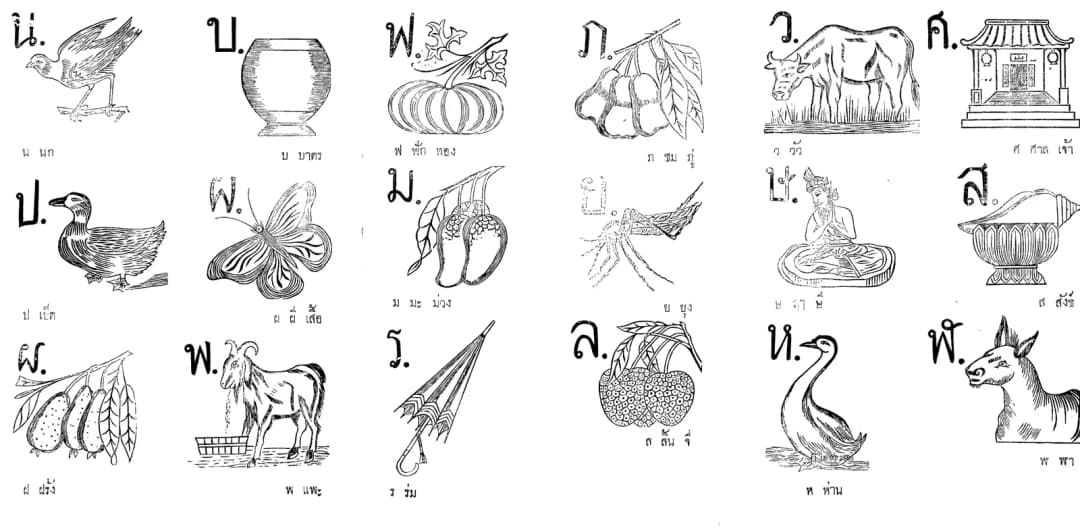
- Reading and writing. Some courses teach the script from the start, others later. At Chulalongkorn, students start the Thai alphabet in Intensive Thai 2. Ask before you pay.
What you get for the money#
Price per hour is the easiest way to compare. Duke's group course works out at 200 baht an hour, and its 200-hour package at 180 baht an hour. Chulalongkorn's on-site course is 295 baht an hour, but it is far more intensive: 15 hours of class a week, plus a weekly language and culture session. The programme has nine six-week courses in three levels (beginner, intermediate and advanced). A private lesson at Duke costs about three and a half times the group rate per hour, but all the speaking time is yours.
Hours add up at very different speeds. Four hours a week for a year is about 200 hours; at 15 hours a week, an intensive student reaches that in about 13 weeks of class.
Group, private, intensive or online: which format fits#
Group classes, part-time. Suits most working residents: two-hour classes on set weekdays, or evening and weekend slots, at a price that makes long-term study affordable. Duke runs morning, afternoon, evening and weekend Thai groups (Duke).
University intensive. Suits people who can give six weeks of weekdays and want a clear syllabus and exams. Chulalongkorn's courses start in odd-numbered months, and people who already speak some Thai can ask the centre for a placement test (Chulalongkorn CTFL). The centre is in the Faculty of Arts on Phaya Thai Road, close to Siam.
Private lessons. Suits busy executives, people with an irregular schedule, or anyone with a specific goal such as business meetings, a Thai partner's family or a reading test. If a school sells blocks of hours, check how long they stay valid.
Online. Useful between trips or before you arrive. If you need a student visa, ask the school whether an online course can support it.
Studying Thai on an ED visa in 2026#
The Non-Immigrant ED visa lets you stay in Thailand to study. A language school counts as a private non-formal school, and it can only support a visa if it holds a licence from its supervising authority and can issue the documents for the visa and for every extension (Louis Group).
How long you can stay#
According to Louis Group, under Immigration Bureau Order No. 12/2568, in force since 23 January 2025, a language-school student gets:
- 90 days on arrival with the visa,
- extensions of up to 90 days at a time, at 1,900 baht each,
- a total stay of no more than one year from the date of entry (or from the date a change of visa category inside Thailand was approved). Enrolling in another course does not extend that year (Louis Group).
Some schools still sell packages longer than one year. Bangkok Language School lists a 14-month course with an extra 2,000-baht stamp for the second period (Bangkok Language School), and Duke says a second ED visa can take the total stay to up to 14 months (Duke). Ask the school exactly how a long package works with the one-year rule before you pay.
What changed in 2025#
For years some people bought an ED visa package and never went to class. The authorities moved against this in 2025:
- The 2025 Immigration order requires language-school students to submit the course content, timetable and hours attended with each extension, and permission to stay ends when the reason for staying no longer matches the reason it was granted (Louis Group).
- Thai media reported in 2025 that language courses must run at least four days a week, two hours a day, and that schools must remove students who miss more than seven days. Louis Group notes it could not find a published instrument for this, so treat it as reported practice (Louis Group).
- In August 2025 the Higher Education Minister said the visas of nearly 10,000 foreign students in short non-degree university courses had been revoked because the courses did not meet the ministry's new rules, in force since 14 May 2025 (Khaosod English). These rules apply to short courses at higher-education institutions.
For a student who actually attends, none of this is a problem. Keep your attendance record and coursework, as you may need to show them at an extension.
Applying from abroad or in Bangkok#
From abroad. Thai visas are applied for online through the Thai e-Visa system, using the school's letters. As one example, the Royal Thai Embassy in Washington asks language students for bank statements for each of the last three months with an ending balance of at least USD 1,000, and charges USD 80 (Louis Group). Each embassy sets its own document list, so check yours.
In Bangkok. Schools can convert a visa-exempt entry into an ED visa, but you need time. Duke asks students to have at least 50 days left on their permitted stay, then allows three to four weeks for Ministry of Education approval and 15 days for Immigration (Duke). That matters more since 15 September 2026, when visa-free entry for 60 countries and territories, including the UK, the US, Australia and several EU countries, fell from 60 to 30 days (TAT Newsroom). On a 30-day stamp you would need a 30-day extension of stay first, which Bangkok Language School lists at 1,900 baht (Bangkok Language School). Applying from abroad avoids this extra step.
Rules that catch students out#
- Re-entry permit. If you leave Thailand without one, your permission to stay ends. Bangkok Language School lists a single permit at 1,000 baht and a multiple permit at 3,800 baht, and says reinstatement after leaving without one costs at least 5,000 baht (Bangkok Language School).
- 90-day reports. Separate from extensions. Late reporting carries a fine.
- No work. A student visa does not allow work. Working without a work permit, including tutoring or shifts at a bar, is punishable by a fine of 5,000 to 50,000 baht and removal from Thailand (Louis Group). If you plan to work, read our guide to the work permit in Thailand.
- Refund terms. If the Ministry rejects your application, Duke refunds the fee minus a 2,000-baht administrative fee (Duke), while Bangkok Language School keeps 10,000 baht (Bangkok Language School). Neither refunds if Immigration refuses the visa after Ministry approval. Read the refund policy before paying in full.
If you plan to stay for several years rather than one, compare the ED visa with the Destination Thailand Visa (DTV), and for extension procedures generally see our guide to visa extensions in Bangkok.
How to choose a Thai language school#
- Decide your goal first. Speaking for daily life, reading and writing, or a business level? Ask the school to show you its syllabus for that goal.
- Check the location against your commute. Duke is on Sukhumvit Soi 13 in the Nana area, Chulalongkorn's Thai centre is near Siam, and AUA's head office is on Rajdamri Road. A school close to your condo or office is easier to keep attending. Renting first? Our guide to renting a condo in Bangkok explains how to choose an area.
- Ask about class size and the timetable. How many students per class, and how many days a week? Some learners prefer twice a week, others want daily lessons.
- Take a trial lesson. Duke offers a free trial lesson (Duke); ask other schools whether they do the same. Use it to judge the teacher's English, how much you speak and how the class handles tones.
- For a visa, ask three questions. Is the school licensed? Can it issue the documents for every extension? What happens to your money if the Ministry or Immigration says no?
- Compare cost per hour, not package price. Divide the price by the number of class hours, then add textbooks and government fees.
- Be wary of "visa-only" offers. A package that promises a visa with little or no attendance is exactly what the 2025 checks target, and you carry the risk.
Where to look on bangkok.biz#
Our education directory lists language schools, international schools and training centres across Bangkok, including Duke Language School and Chulalongkorn University, so you can shortlist schools near you, for example in Asok. Families moving to the city can also read our guide to international schools in Bangkok by area, and if you also want to train, see our Muay Thai guide for beginners.
FAQs#
How much do Thai lessons cost in Bangkok? At Duke Language School, a 40-hour group course costs 8,000 baht (200 baht an hour) and private Thai lessons cost 700 baht an hour. Chulalongkorn University's intensive course is 29,500 baht for 100 hours on site. Prices are as published in November 2026.
How long does it take to learn Thai? It depends on the hours you put in. A six-week intensive course at Chulalongkorn gives you 100 hours of structured study; a part-time learner at four hours a week needs about six months to reach the same number of hours. Practice outside class adds to that.
Can I get a student visa to learn Thai? Yes, through a language school licensed to support the Non-Immigrant ED visa. You get 90 days on entry and extensions of up to 90 days, with a maximum of one year in total, and you must show your timetable and attendance at each extension.
Can I extend a Thai language ED visa beyond one year? According to Louis Group, not on the same stay: the one-year limit is a ceiling, and enrolling in another course does not extend it. Some schools sell packages of up to 14 months; ask the school how its package works with this rule.
Can I work while studying Thai on an ED visa? No. A student visa does not allow work, and working without a work permit is punishable by a fine of 5,000 to 50,000 baht and removal from Thailand.
Can I come visa-free and switch to a student visa? It is possible, but since 15 September 2026 visa-free entry for 60 countries and territories, including the UK, the US and Australia, is 30 days. Duke asks for at least 50 days left on your stay before an in-country application, so you would need a 30-day extension first.
Should I learn to read Thai? If you are staying long term, it helps: menus, signs and documents become easier. Ask whether the course teaches the script or sells it separately.
Cite or reuse this guide
You may quote, translate or republish the text of this guide, also in your own work, under CC BY 4.0. Name Bangkok.biz and link to this page. Photos and listing data are not included. How to reuse our guides
"Learning Thai in Bangkok in 2026: Language School Prices, ED Visa Rules and How to Choose a Course", Bangkok.biz, updated 16 November 2026, https://bangkok.biz/guides/learn-thai-language-school-bangkok (CC BY 4.0)<a href="https://bangkok.biz/guides/learn-thai-language-school-bangkok">Learning Thai in Bangkok in 2026: Language School Prices, ED Visa Rules and How to Choose a Course</a> by <a href="https://bangkok.biz">Bangkok.biz</a>, licensed under <a href="https://creativecommons.org/licenses/by/4.0/">CC BY 4.0</a>